Every July 11, the world marks World Population Day. The UN started it in 1989, a nod to the day in 1987 when the planet crossed five billion people. In 2026 we are past 8.3 billion, and India sits at the top of the list at roughly 1.46 billion, having moved ahead of China back in 2023.
This year’s UN theme is about young people, their hopes, and the futures they are trying to build. The 2026 report found something that stops you for a second: across most of the countries surveyed, the biggest reason young adults have fewer children than they want is not desire. It is cost. Job worries and, right at the top, the price of a home.
That is where a global observance lands very close to home in Gwalior.
Because behind every population figure is a family looking for a decent place to live. And in Gwalior, the story of where those families are going is the real estate story of the decade. Having helped over 10,000 families settle into homes across this city, we wanted to use this day to walk you through it honestly: how many of us there actually are, where the city is heading, and where a home bought today is likely to serve you best twenty and thirty years out.
How many people live in Gwalior in 2026?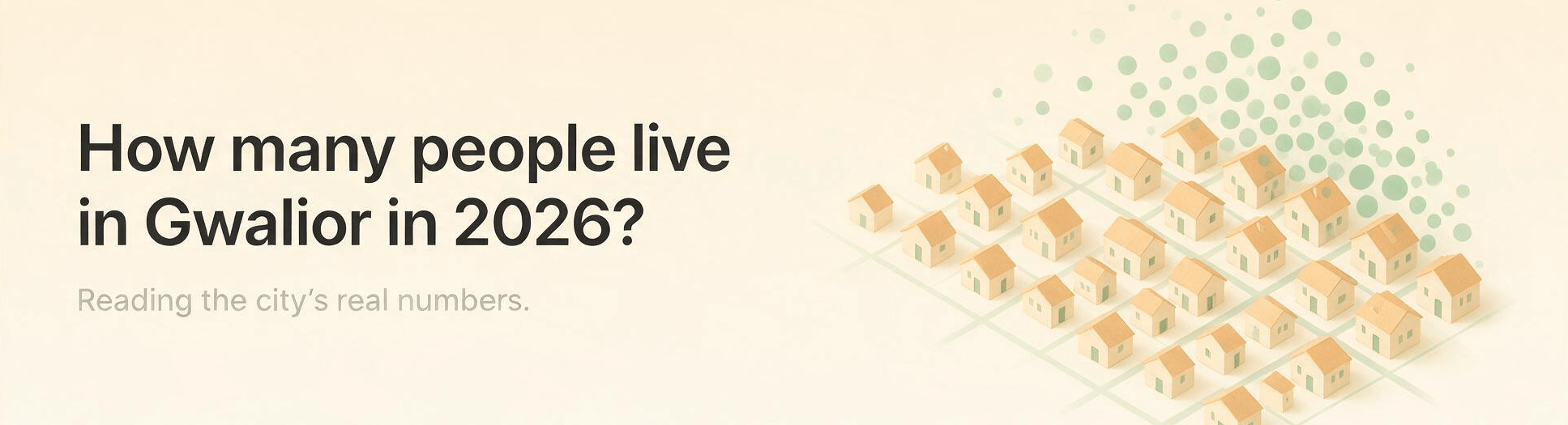
Gwalior’s population in 2026 is estimated at around 16 lakh for the city and close to 16.8 lakh for the wider metro area. At the district level the figure is upward of 24 lakh.
A caveat worth saying plainly: the last official census was in 2011, which counted about 10.7 lakh in the city and 11.2 lakh in the metro region. The 2021 census was postponed during COVID and has not been completed, so every current number is an estimate built on the roughly 2.5 percent annual growth Gwalior has shown for decades. Treat the figures as directional, not gospel.
Even at the conservative end, the direction is clear. A 2.5 percent yearly rise means Gwalior adds somewhere near 40,000 residents a year. That is close to 10,000 new households annually, each one needing a roof. Gwalior’s literacy rate of about 84 percent runs well above the state average, and more than two in three district residents now live in the urban area rather than the villages around it.
More people, concentrating in the city, with rising incomes. That combination is the quiet engine under every property price in Gwalior.
Why population growth moves property prices
When a city grows, its land almost always follows, upward. Every new resident needs a home, a school within reach, a hospital, a market. Cities that plan for this by building organised townships, widening roads, and investing in water and power tend to reward the people who bought in early. The ones that do not plan get congestion, chaos, and falling quality of life instead.
Gwalior in 2026 sits at the good end of that split. Population is climbing, infrastructure is being rebuilt at pace, and organized township development is finally giving families a real alternative to the crowded old city. That is the honest link between a UN awareness day and your next property decision. You are not betting on a hunch. You are taking a position on a demographic trend that is about as certain as anything in investing gets.
A history of Gwalior real estate
Land in Gwalior has moved through four rough phases, and knowing them helps you read the market today.
Under the Scindias, before 1947, there was no property market in any modern sense. There were palaces and estates on one side and tightly packed mohallas in Lashkar and Hazira on the other. Ownership often meant long possession, not a registered deed.
After Madhya Bharat merged into Madhya Pradesh in 1956, Gwalior turned from a royal capital into an administrative and industrial city. Government built worker colonies and quarters, and areas like Vinay Nagar, Padav, and parts of Morar took shape under public planning.
From the 1980s the industrial middle class grew, and private builders arrived, but without rules. Colonies in Thatipur, Bahodapur, and along Agra Road came up in an unorganised way, with informal agreements and frequent disputes. Flats in that era went for a few hundred rupees a square foot. If you wanted a house, you usually built it yourself.
The real shift came after RERA took effect across India in 2016. Buyers started asking for registration, escrow protection, and a possession date they could hold a builder to. Unorganised builders who could not meet that standard began to exit, and trusted developers gained ground. Over the last twelve months prime Gwalior localities have seen 11 to 15 percent year-on-year appreciation, driven by scarce central land, rising construction costs, and a clear buyer preference for gated, planned living.
That is the market you are buying into now. Two Gwaliors, really: the crowded old city where resale flats and independent houses dominate, and the new-city townships where you get RERA protection, amenities, and room to grow.
What Gwalior looks like right now: prices and infrastructure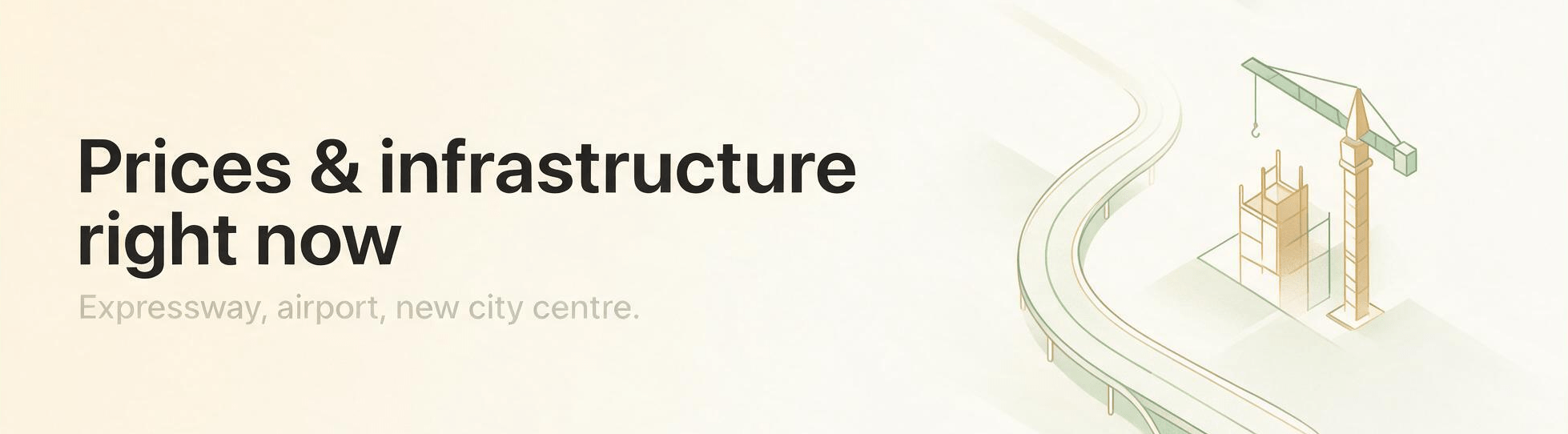
Three big projects are maturing at the same time, and each one is repricing the land around it.
The Gwalior to Agra Expressway is turning the city into a logistics point for north India, with the sharpest land movement along the Northern Bypass and Morar periphery. The airport expansion at Maharajpura has lifted demand along Airport Road for both commercial and hospitality use. And the shift of the District Court and Collectorate to the New City Centre at Dongarpur has quietly made that area Gwalior’s emerging premium address. Add a proposed metro and BRTS expansion, plus AIIMS Gwalior reshaping the city’s healthcare profile, and you have more simultaneous infrastructure investment than Gwalior has seen in a generation.
Here is roughly where prices sit as of July 2026. These are indicative and worth confirming with our team before you decide.
| Locality | Flat price (per sq ft) | 2 BHK range | Rental yield |
|---|---|---|---|
| City Centre / Lashkar | Rs 4,000 to 5,900 | Rs 40 to 55 lakh | ~3% |
| New City Centre (Dongarpur) | Rs 3,500 to 5,500 | Rs 38 to 65 lakh | 3 to 5% |
| Thatipur | Rs 3,200 to 4,500 | Rs 30 to 45 lakh | 4 to 6% |
| Jhansi Link Road | Rs 3,000 to 4,500 | Rs 28 to 50 lakh | 3 to 5% |
| Maharajpura / Airport Road | Rs 2,800 to 4,200 | Rs 25 to 45 lakh | 3 to 4% |
| Morar | Rs 2,500 to 3,800 | Rs 22 to 40 lakh | 3 to 4% |
Prime corridors are expected to rise another 12 to 15 percent through 2026. For reference, Neoteric Eden Garden on Jhansi Link Road (RERA P-GWL-22-3109) offers 2,3&4 BHK Flats, with carpet areas starting from 695 sq ft in a fully planned gated township.
Where the demand is really coming from
Population only lifts property when jobs and income come with it. Gwalior has both.
Banks, insurers, and IT firms are expanding here to cut costs, drawn by an educated workforce, three universities, and a low cost of living. That pulls in exactly the young professionals who rent and then buy 1 and 2 BHK flats. Grade-A office space like Neoteric One Business Centre is generating 7 to 9 percent rental yields, close to triple what residential flats return.
The expressway has turned Gwalior into a warehousing and logistics node on the northern arm of the Delhi to Mumbai corridor, bringing workforce demand along NH-75 and the Northern Bypass. AIIMS is seeding an entire healthcare cluster of colleges, diagnostics, and stable medical jobs. The city’s boarding schools, from Scindia School to Delhi Public School, keep drawing families from across MP and UP who buy homes here specifically for their children. And Morar Cantonment anchors a large, dependable defence community.
This is demand backed by employment, not speculation. That distinction matters when you are committing for decades.
Where families are moving inside the city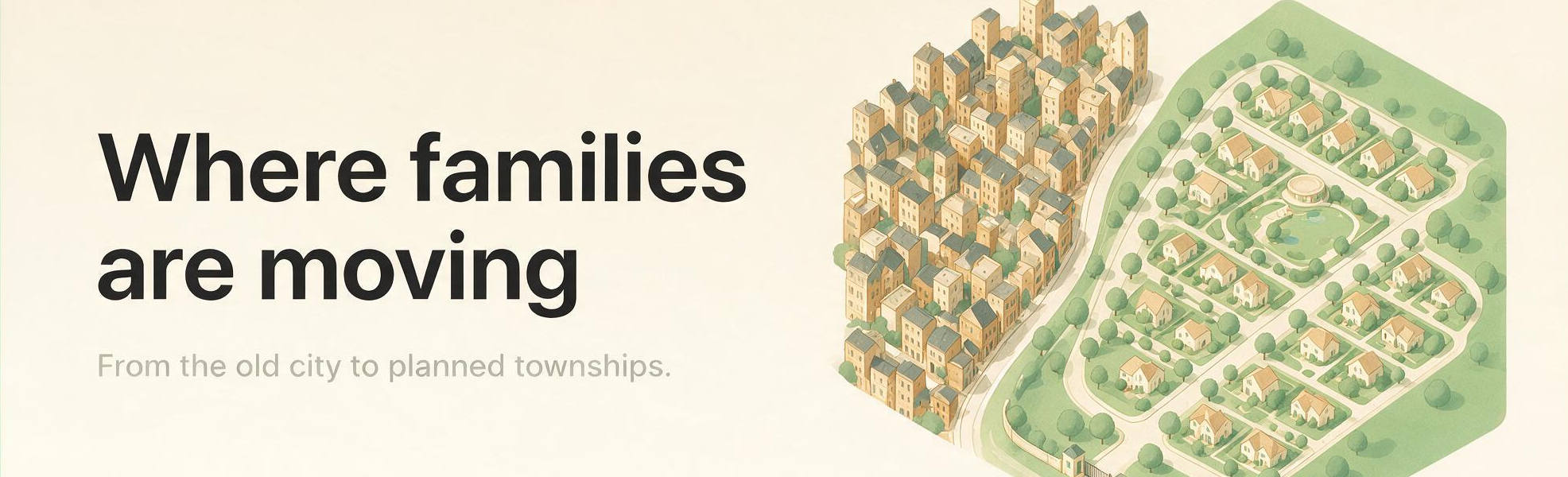
The single clearest trend in Gwalior right now is the move from old-city density to planned-township space. Families in Lashkar, Morar, Sipri Bazaar, and Bahodapur, worn down by congestion and thin infrastructure, are the most active buyers in the new corridors. Lashkar remains the most crowded part of the city, with streets too narrow and land too scarce for meaningful new construction.
The growth is happening in three zones. Thatipur, the bridge between old and new Gwalior, carries the city’s highest rental yield at 4 to 6 percent on the back of student and young-professional demand. New City Centre at Dongarpur has climbed 15 to 18 percent over two years as the government moved its institutions there. And Jhansi Link Road with Sirol is the fastest-growing residential corridor in the city, with analysts expecting 15 to 18 percent land appreciation this year off the back of the new infrastructure.
This migration is structural, not a passing phase. It will run for the next twenty to thirty years as the middle class grows and expects more from where it lives.
The best areas to buy in Gwalior for a 20 to 30 year horizon
If you are choosing a home to raise a family in and hold for decades, the question is not where is cheapest today. It is where Gwalior’s best living will be in 2050. Four things decide that: infrastructure that is funded and coming, social infrastructure like schools and hospitals within fifteen minutes, the quality of the community you are joining, and long-term appreciation. Here is our honest read.
Jhansi Link Road scores highest across all four. Direct NH-75 and expressway links, the proposed metro route aligned to it, reputed schools and hospitals within reach, and RERA-registered township living. This is where Neoteric Eden Garden (P-GWL-22-3109) offers 2,3&4 BHK Flats, and Neoteric Garden City offers approved flats, villas, flats inside a planned community. Land in a developed township here has historically outrun a fixed deposit by a wide margin.
New City Centre (Dongarpur) is the government’s own bet. Relocating the courts and administration here is the strongest possible signal of long-term commitment. The buyer profile is senior officers, doctors, and established professionals, which tends to compound community quality over time. This is home to Neoteric Regal Garden, premium high-rise towers with a temperature-controlled pool, podium amenities, and three-tier security. Early buyers are already seeing 15 to 18 percent appreciation.
Nature Park suits the genuinely long view of 25 to 30 years. Built around nature and wellness, with a hospitality tie-up with Series by Marriott, it lets you enter a premium community before the surrounding infrastructure fully matures. The buyers who come in early here are the ones likely to look back happiest.
What to be careful with: the deeply congested pockets of central Lashkar and Morar look cheap but age poorly, because redevelopment there is slow and buyers keep moving out rather than in. And any unorganised plotted layout without RERA registration carries real risk on disputes and shared-infrastructure upkeep over the decades. For stress-free living across a generation, planned, RERA-compliant townships in the growth corridors are the sensible call.
Rent versus buy, in plain numbers
Take a Rs 70 lakh home at Eden Garden bought with a Rs 40 lakh loan at 8.4 percent over 20 years. The EMI lands around Rs 40,000 a month, which is close to what premium rent for a similar home will cost you within a decade anyway. At a conservative 7.5 percent annual appreciation, that home could be worth around Rs 3 crore in 20 years, and you own it outright at the end with zero monthly housing cost heading into retirement, plus the tax deductions along the way under the old regime.
The family that rents a comparable place at Rs 15,000 today, escalating 8 percent a year, ends up paying roughly Rs 85 to 95 lakh in rent over the same 20 years, with no asset to show for it. Population growth means housing demand is not going to fall. Buying into an organized township today puts you on the right side of that certainty.
Frequently asked questions
What is Gwalior’s population in 2026?
Gwalior’s city population in 2026 is estimated at around 16 lakh, with the metro area near 16.8 lakh and the district above 24 lakh. The last official census was 2011 (10.7 lakh city, 11.2 lakh metro); the 2021 census was postponed, so 2026 figures are estimates based on roughly 2.5 percent annual growth.
How fast is Gwalior growing?
Gwalior grows at roughly 2.5 percent a year, close to the 2.59 percent recorded in the 2001 to 2011 census decade. At that rate the city adds around 40,000 residents annually, near 10,000 new households. This steady growth, paired with rising incomes and infrastructure investment, is the core driver of housing demand across the city.
Which are the most densely populated areas in Gwalior?
The most crowded areas are the old-city zones of Lashkar, Hazira, Morar, and Bahodapur. These have narrow streets, little open space, and strained infrastructure, which is why families are steadily moving out toward planned corridors like Jhansi Link Road and New City Centre in search of space and amenities.
Which is the best area to buy a flat in Gwalior for the next 10 to 20 years?
Jhansi Link Road and New City Centre are the strongest long-term choices. Jhansi Link Road, home to Neoteric Eden Garden (RERA P-GWL-22-3109) and Garden City, offers township infrastructure and strong land appreciation. New City Centre at Dongarpur is Gwalior’s emerging premium address as the administrative hub matures. Both are RERA-compliant and well connected.
Why is Gwalior real estate growing so fast in 2026?
Three infrastructure milestones are maturing at once: the Gwalior to Agra Expressway, the Maharajpura airport expansion, and the New City Centre administrative shift. Together with 2.5 percent annual population growth and expanding IT, logistics, and healthcare jobs, demand is outpacing organized supply, pushing prime-corridor prices up 12 to 15 percent a year.
Is Neoteric Properties RERA registered?
Yes. Neoteric Eden Garden on Jhansi Link Road is RERA registered as P-GWL-22-3109 under the Madhya Pradesh Real Estate Regulatory Authority, verifiable at rera.mp.gov.in. All Neoteric projects follow RERA standards, meaning transparent possession timelines.
What does World Population Day have to do with buying a home?
World Population Day, observed every July 11, highlights how population trends shape daily life. In 2026 the UN theme focuses on young people, and its research names housing cost as a top barrier to family formation. For Gwalior families, that underlines why owning a home in a growing city, ahead of the demand curve, matters more than ever.
In closing
World Population Day is a reminder that our most basic shared challenge is not oil or food. It is space. Liveable, safe, well-connected space for the families that make up a city. In Gwalior, that space is being built right now, and the families choosing planned townships today are the ones taking a stake in the city’s next thirty years.
If you want to talk it through, our expert team is happy to help you find the home that fits your family and your horizon.
Enquire Now to start the conversation.